
In today’s fast-paced business environment, efficiency is everything. Companies that fail to optimize their workflows often struggle to keep up with competitors. This is where AI for business productivity becomes a powerful advantage. By automating repetitive tasks, analyzing data, and improving decision-making, AI allows businesses to achieve more with fewer resources.
Whether you’re a small business owner, freelancer, or part of a growing team, understanding how to use AI effectively can transform your daily operations. From simple AI tools to save time to advanced workflow automation systems, businesses are increasingly relying on artificial intelligence to streamline processes.
In this guide, you’ll learn proven strategies for using AI to improve productivity, practical tools you can implement immediately, and how to avoid common pitfalls.
What Is AI for Business Productivity and Why It Matters
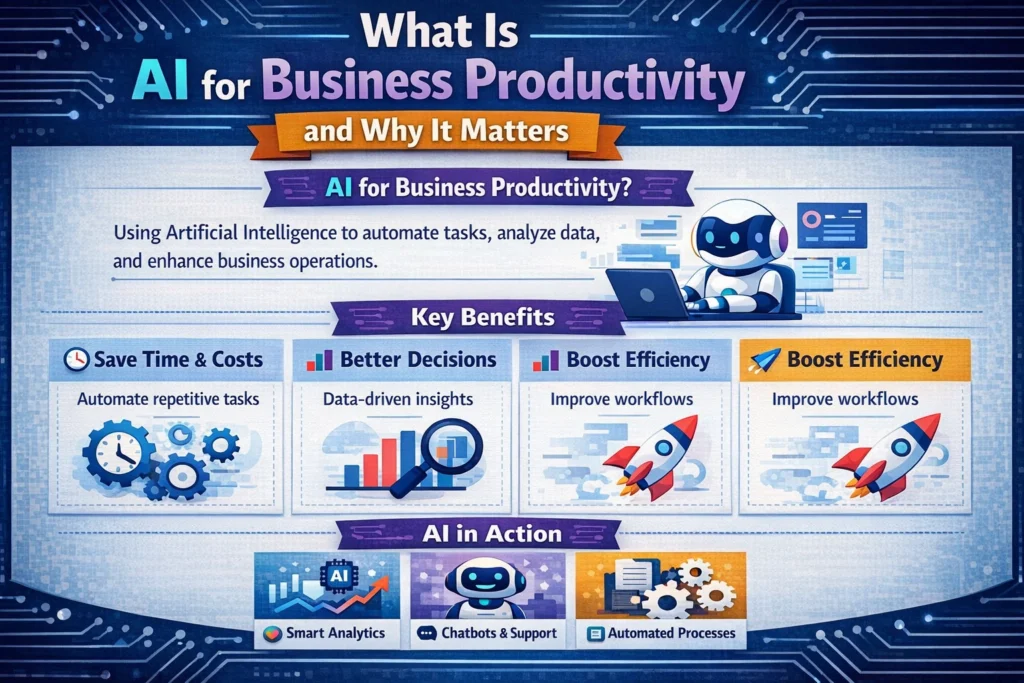
Before diving into tools and strategies, it’s important to understand what AI for business productivity actually means. At its core, it refers to using artificial intelligence to optimize tasks, workflows, and decision-making processes within a business.
AI systems can handle large amounts of data quickly, identify patterns, and perform tasks that would otherwise require human effort. This makes them ideal for improving productivity in areas such as customer support, marketing, finance, and operations.
One of the biggest reasons AI matters today is time efficiency. Many businesses waste hours on repetitive tasks like email management, data entry, and scheduling. With the right AI workflow tools, these tasks can be automated, freeing up time for more strategic work.
Another key benefit is accuracy. Human error can lead to costly mistakes, especially in data-driven tasks. AI minimizes these risks by providing consistent and reliable outputs.
Additionally, AI enables better decision-making. By analyzing data in real time, businesses can respond quickly to changes and opportunities.
Ultimately, adopting AI is not just about working faster—it’s about working smarter. Companies that leverage AI effectively can increase output, reduce costs, and improve overall performance.
Proven Ways to Increase Productivity with AI
There are many ways to increase productivity with AI, but focusing on the right areas will deliver the best results. Below are some proven methods that businesses are using successfully.
Automate Repetitive Tasks
One of the simplest ways to improve productivity is by automating routine tasks. This includes:
- Email responses
- Data entry
- Appointment scheduling
Using AI for these tasks eliminates manual effort and reduces errors. Tools like AI assistants and automation platforms can handle these processes seamlessly.
Improve Communication and Collaboration
AI tools can enhance team communication by summarizing meetings, generating notes, and even suggesting action items. This ensures that everyone stays aligned without spending extra time on administrative work.
Enhance Content Creation
Content creation can be time-consuming. AI tools can generate drafts, suggest ideas, and optimize content for SEO. This is one of the most practical AI productivity tips for businesses that rely on marketing.
Optimize Decision-Making
AI analyzes data faster than humans, providing insights that help businesses make better decisions. Whether it’s identifying trends or predicting outcomes, AI adds a strategic advantage.
Streamline Workflows
By integrating multiple tools into one system, AI can automate entire workflows. This is where AI workflow tools become essential, connecting different processes into a smooth, efficient pipeline.
These strategies demonstrate how AI can be applied across different areas to improve productivity significantly.
Best AI Tools to Save Time and Boost Efficiency
Choosing the right tools is crucial when implementing AI for business productivity. Here are some categories and examples of tools that deliver real value.
AI Writing and Content Tools
These tools help generate content, emails, and reports quickly. They are especially useful for marketing teams and business owners.
AI Scheduling Assistants
Scheduling meetings manually can be time-consuming. AI assistants automate this process by finding the best time slots and sending reminders.
AI Project Management Tools
These tools track progress, assign tasks, and provide insights into team performance. They are ideal for improving collaboration and accountability.
AI Data Analysis Tools
Analyzing data manually is inefficient. AI tools process large datasets quickly, providing actionable insights.
AI Automation Platforms
These platforms connect different applications and automate workflows. They are essential for businesses looking to implement using AI at work effectively.
By selecting the right combination of tools, businesses can significantly reduce manual work and improve efficiency.
How to Implement AI in Your Daily Workflow
Implementing AI doesn’t require a complete overhaul of your business. In fact, the most effective approach is gradual adoption.
Step 1: Identify Time-Consuming Tasks
Start by analyzing your daily operations. Identify tasks that take the most time but provide low value.
Step 2: Choose the Right Tools
Select tools that address your specific needs. Avoid using too many tools at once—focus on a few that deliver the highest impact.
Step 3: Train Your Team
Ensure that your team understands how to use AI tools effectively. Proper training is essential for maximizing productivity.
Step 4: Monitor Performance
Track how AI is impacting your workflows. Measure time saved, efficiency improvements, and overall productivity.
Step 5: Optimize Continuously
AI systems improve over time, but only if you refine them. Regularly update processes and adjust strategies.
By following these steps, businesses can integrate AI smoothly and achieve long-term productivity gains.
Common Mistakes to Avoid When Using AI at Work
While AI offers many benefits, improper use can reduce its effectiveness. Understanding these mistakes will help you avoid setbacks.
Over-Reliance on Automation
AI is a tool, not a replacement for human judgment. Over-automation can lead to poor decision-making.
Lack of Clear Goals
Implementing AI without a clear objective can result in wasted time and resources.
Ignoring Data Quality
AI depends on accurate data. Poor data leads to poor results.
Using Too Many Tools
Too many tools can create confusion and inefficiency. Focus on a streamlined system.
Neglecting Human Interaction
Customer relationships still require a human touch. AI should enhance—not replace—these interactions.
Avoiding these mistakes will ensure that your use of AI for business productivity remains effective and sustainable.
FAQ: AI for Business Productivity
1. What is AI for business productivity?
It refers to using artificial intelligence to automate tasks, improve workflows, and increase efficiency within a business.
2. How can AI tools save time?
AI tools automate repetitive tasks, analyze data quickly, and streamline workflows, reducing manual effort.
3. Are AI workflow tools suitable for small businesses?
Yes, many tools are designed specifically for small businesses and offer affordable pricing.
4. Can AI replace employees?
No. AI assists with tasks but still requires human oversight and decision-making.
5. What are the best AI productivity tips?
Focus on automation, use the right tools, and continuously optimize your workflows.
Conclusion: Start Using AI for Business Productivity Today
The benefits of AI for business productivity are clear—faster workflows, reduced costs, and improved decision-making. Businesses that adopt AI strategically can gain a significant competitive advantage.
The key is to start small. Identify one area where AI can make an immediate impact, implement the right tools, and build from there. Over time, you’ll create a system that not only saves time but also drives growth.
If you want to work smarter, not harder, now is the time to embrace AI.
👉 Take action today: start exploring AI tools, apply the strategies in this guide, and begin transforming your business productivity.
